
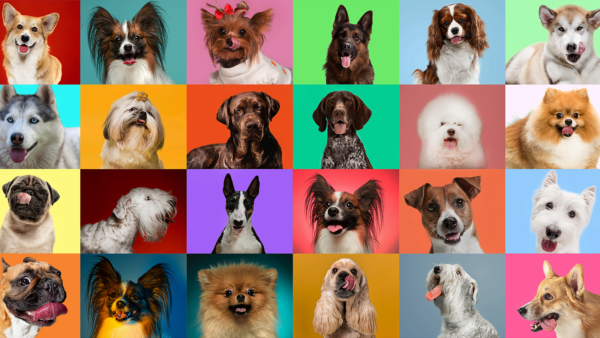
Man’s best friend is helping scientists unlock the secrets of genetic diversity. In a recent collaborative study, Dr. Jeffrey Kidd, professor of Human Genetics and Computational Medicine & Bioinformatics at the University of Michigan Medical School, led the computational effort to assemble the canine genome with unprecedented clarity, a crucial step toward understanding how DNA mutations drive complex diseases across species.
DNA sequencing at this level of detail requires massive computational power, which was provided by U-M’s Information and Technology Services’ Advanced Research Computing (ARC) team.

Dr. Jeffrey Kidd
The Computational Challenge
To study hereditary diseases, scientists traditionally analyze an animal’s genome as a single, averaged sequence. However, this blurs the unique genetic details inherited individually from the mother and father. Dr. Kidd’s team changed that by successfully putting together both sets of parental chromosomes across five canines. They compiled these 10 highly accurate genetic maps into a master “pangenome graph” to pinpoint how “jumping genes” (mobile DNA elements) actively drive structural variation in dog DNA.

Dog genome variation represented as a “tube map.” Each line is an assembled chromosome sequence.
Building and aligning 10 parallel genome maps simultaneously is no small feat; it is an incredibly data-heavy task that would stall standard desktop hardware. To address this bottleneck, Dr. Kidd’s lab turned to ARC’s Great Lakes high-performance computing cluster, utilizing large-scale parallel processing to bring processing times down from months to days. That speed and scale made ARC a valuable partner in a highly complex international research effort. Because Dr. Kidd’s group could take on computational work that many labs would not have been able to complete quickly or efficiently, the team was invited to collaborate on an international study, recently published in the highly respected journal, NAR Genomics and Bioinformatics.
“I wanted to pass along my thanks for the great ARC/Great Lakes support,” Dr. Kidd wrote in an email to ARC leadership. “These resources and the U-M Research Computing Package were instrumental in a recent publication. We were invited to help because of our ability to quickly handle compute tasks.”
Bridging the Gap
This high-resolution mapping provides a vital framework for unlocking the genetic roots of complex diseases across species. Because dogs share over 350 inherited diseases with humans, including similar forms of cancer, epilepsy, and heart disease, mapping these genomes opens new doors for medical discoveries. The new genomes also highlight the evolutionary relationships among dogs and help to pinpoint how dogs differ from each other. Looking forward, the rapid computational methods used on ARC’s Great Lakes cluster could help researchers better understand how structural variations in DNA contribute to shared illnesses, accelerating treatment discoveries for both veterinary and human medicine.
Following the publication, Dr. Kidd reached out to introduce a few key players from the study:
“I know there are several dog lovers in the ARC team,” he said. “Here is a picture of some of the individuals whose genomes we studied.”
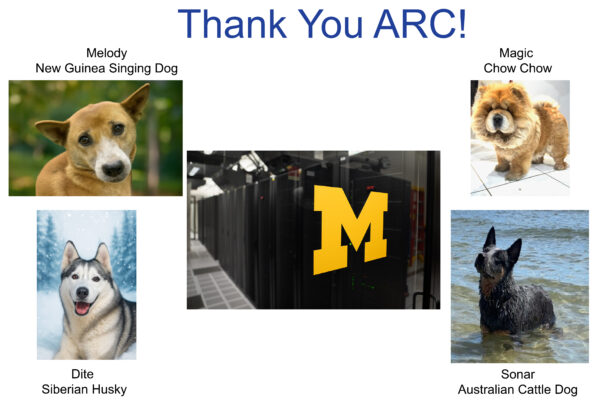
Photos courtesy of Bill Ballard, Alan Brooks, Robyn Foster, and David Simpson. The journal article notes: “No animals were housed as part of this study. Blood samples were collected from animals under protocols approved by the University of New South Wales.
U-M Research Computing Package (UMRCP)
The U-M Research Computing Package (UMRCP) makes 80,000 CPU hours per year on ARC’s high-performance clusters and up to 10TB of storage available to eligible U-M researchers, at no cost. Additionally, for researchers within Michigan Medicine, Health Information Technology & Services (HITS) provides the Michigan Medicine Research Computing Investment (MMRCI) that expands upon UMRCP allocations and includes secure environments specifically equipped to support Protected Health Information (PHI).
Need help with your own computational bottlenecks? ARC can get you started. Connect with the team at [email protected] for technical guidance and project support.


