
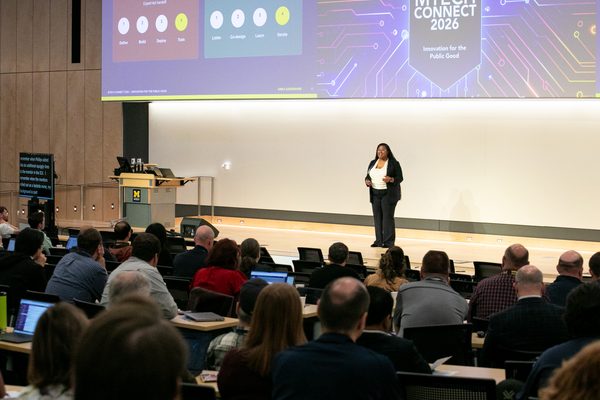
Centering the diverse human experience is crucial for advancing technology and innovating for the public good. Anika Gardenhire, chief digital and information officer for Michigan Medicine, challenged nearly 400 technology leaders from across the University of Michigan to rethink their tech strategies in pursuit of putting people first during her keynote address at the MTech Connect conference.
“The future of technology will not be defined only by the sophistication of our AI, the scale of our cloud platforms, the power of our analytics, or the number of capabilities we deploy,” Gardenhire said. “It will also be defined by who benefits.”
Most technology companies, such as Microsoft, Google, and Apple, build their products for general users, leaving “edge cases” to adapt to the technology or not use it at all.
“We frequently design around averages because averages make complexity manageable,” Gardenhire shared during her keynote address. “They help us write requirements, standardize processes, estimate demand, and scale services. But an average is a mathematical construction. It is not a person.”
Because Gardenhire started her career as a nurse, her approach is to put the person affected and their experiences first. She argues those edge cases should be at the center of our technology designs.
“People at the edges often experience the friction first,” Gardenhire said. “They see what our mainstream users have simply learned to tolerate. When we design with them, we do not create niche solutions. We uncover needs, reduce complexity, expand adoption, and often create something better for everyone. The organizations that thrive will be the ones that stop treating people at the edges as afterthoughts.”
The talk highlighted innovation for the public good through collaboration, accessibility, and inclusion, discussing whom technology serves, whose attention it consumes, and what becomes possible when we design differently.
Jasmine Wheaton, senior business process consultant with Health Information Technology Services and co-chair of the event, said the team was lucky to have Gardenhire join the conference with such a relevant topic.
“People were absolutely thrilled with her keynote and felt energized and truly seen,” she said. “I cannot thank Anika enough on behalf of the MTech Connect planning committee, the steering committee, and all the attendees.”
Those sentiments were found throughout the rest of the event, too. Rose Moya, senior project manager with the College of Engineering and co-chair of the MTech Community Steering Committee, was delighted the community found Gardenhire’s talk so engaging.
“What makes MTech Connect so remarkable is that it’s built entirely by the community, for the community,” Moya said. “Every session, panel, and connection made at the event happened because colleagues across campus volunteered their time outside of their day jobs to invest in one another. Seeing the energy in the room validates every hour our committee poured into making this happen.”
For a full recap of the event, including recordings of the keynote and the afternoon panel, visit the MTech Connect website.


