What does it take to teach elementary-aged students about privacy and good digital privacy practices? Three students in Sol Bermann’s UMSI course on Privacy, Surveillance, Technology, and Society – Grace Ashworth, Sarafina Chea, and Eric Nielsen – explored the idea in a Fall 2025 class project, conceptualizing a video game, PrivaPals, as the means. Then, over the course of the spring term, they continued work on the game.
Beginning the Build
Over the summer, Isabelle Befidi, Quincy DeKlerk, Jacob Iwrey, Yeji Kim, Rebecca Liu, and Alexander Símon, participants of the Information & Technology Services (ITS) Internship Program, joined forces with the three original conceivers to truly bring PrivaPals to life. Under the sponsorship of the ITS Office of Privacy, they created a beta version of a free-to-play, accessible educational game about online privacy risks.
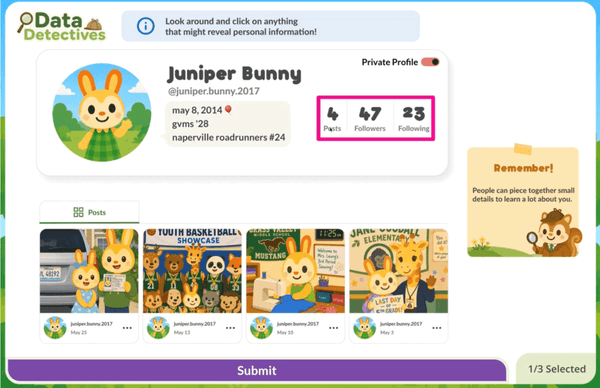
In the game, players are provided age-appropriate scenarios designed to give children a safe and interactive way to practice thinking critically about privacy, and what personal details they reveal online.
Working in Godot, an open-source gaming engine, the developers coded a homescreen complete with character animations and clean transitions. They also designed a game module steeped in learnings from the class project. Using concept art from Bermann’s students, the designers worked in Figma, Adobe Illustrator, and Procreate to animate characters and create new ones.
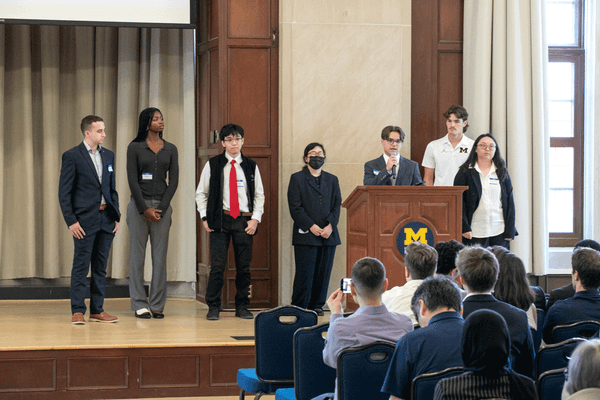
At the ITS Internship Showcase, the students shared their progress with the broader ITS community, highlighting opportunities across U-M for future testing, feedback, and collaboration.
What’s Next
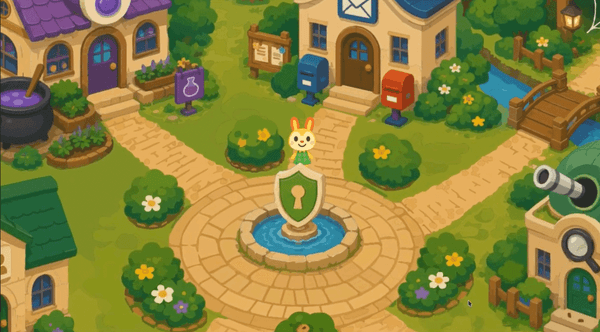
Future plans include creating more educational modules and designing a system to monitor children’s progress. Adding music and voiceovers will also allow designers to support accessibility and a variety of literacy levels. The students also hope to have an option for customizable characters, drawing inspiration from popular games like Animal Crossing. Work on the game is planned to continue into the academic year with help from members of the summer intern cohort and student projects and organizations on campus.
“It’s been exciting to see PrivaPals grow from an idea to a playable game in just a few months,” says Sol Bermann, Executive Director of Privacy and Faculty Affairs. “The students took full ownership of all aspects of this complex project and the results speak for themselves. When we empower our interns to learn and showcase new skills, we not only contribute to their personal and academic growth, but inspire our staff to approach the world with the same curiosity, enthusiasm, and creativity.”


