
This article was written by the Privacy, Education, Engagement, and Policy Services Team with help from U‑M GPT (powered by OpenAI GPT‑5.2).
At the April 16 Summit “Everything That Is Wrong About AI: A Critical Look at Challenges & Opportunities,” co-hosted by ITS and the Provost’s Office, the U‑M community examined AI’s risks and benefits, and how the university could help lead and shape AI adoption.
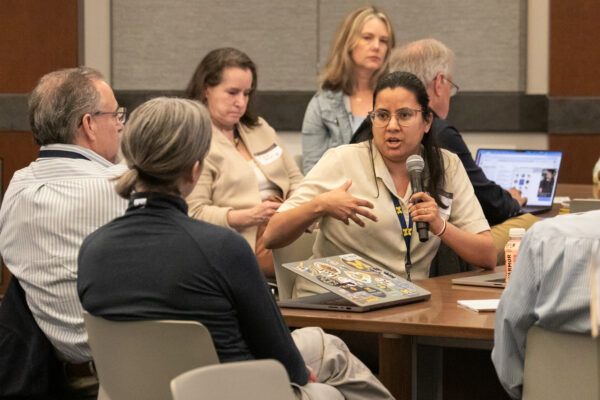
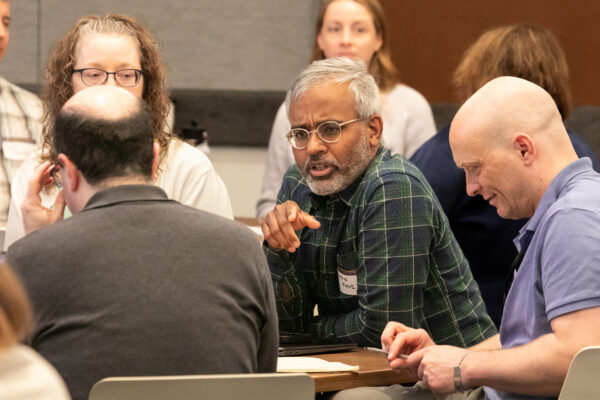
Dr. Ravi Pendse, VPIT-CIO, began with small-group discussions in which each table was given a topic and tasked with examining AI’s impact on jobs, the environment, creativity, and education. They were also asked how the U-M community could address these challenges, as well as what opportunities AI presented. Attendees highlighted risks of cognitive offloading, the environmental and local impacts of data-center growth, and power imbalances between for-profit platforms and the public interest. Table groups urged U‑M to lead through research, advocacy on AI policy, and teaching of AI literacy, with clear expectations for responsible use.
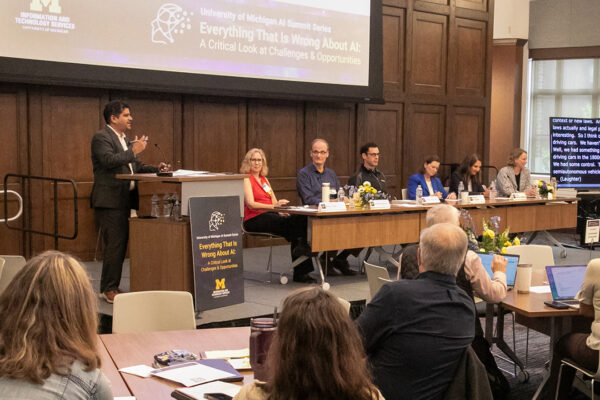
Professor Neel Sukhtame, dean of the U‑M Law School, moderated a faculty panel spanning law, medicine, and LSA. In the education discussion, Derek Peterson, Associate Chair of African History, Chair of SACUA, argued for caution about normalizing AI in ways that weaken learning and trust. Professor Amy Cohn urged faculty to make AI something students analyze — such as critiquing and improving AI-generated drafts — so learning centers on reasoning and communication, not just output. She also encouraged instructors to ask why students turn to AI and to design courses accordingly.
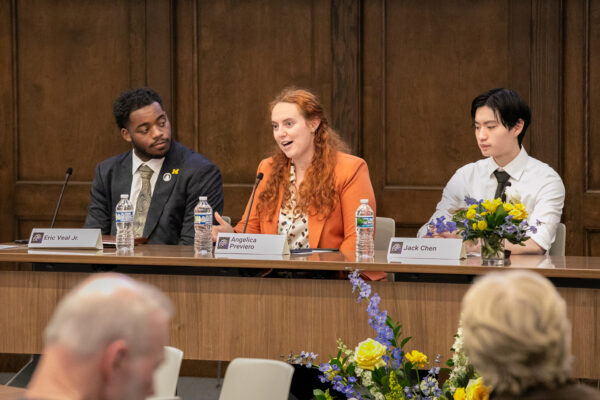
Student leaders emphasized skill-building and meaningful learning. Eric Veal Jr., student body president, called for U‑M to teach essential AI skills and include students in shaping campus tools. Angelica Previero, a doctoral student in Molecular, Cellular, and Developmental Biology and outgoing president of the Rackham Student Government, urged proactive conversations that give students agency as technology changes quickly, and advocated for a learning process focused on conceptual analysis over routine tasks. Jack Chen, a senior studying Computer Science Engineering at U‑M and vice president of the Michigan AI Safety Initiative, noted that busy-work assignments can incentivize AI use; he urged fewer, more meaningful assignments tied to course goals.
In health care, Margaret Dobson, MD, clinical associate professor of Family Medicine and associate chair of Family Medicine, cautioned against replacing clinicians with AI in ways that erode trust and outcomes, and she warned of a two-tier future in which some patients receive AI-only care while others see human doctors supported by AI. She supported AI for productivity tasks like documentation and anticipated future training that shifts toward “human skills over memory work.” Dr. Todd Hollon, MD, a research professor of neurosurgery and leader of the Machine Learning in Neurosurgery Lab, emphasized the broader upside, citing AlphaFold’s protein-structure predictions as an example of AI accelerating discovery.
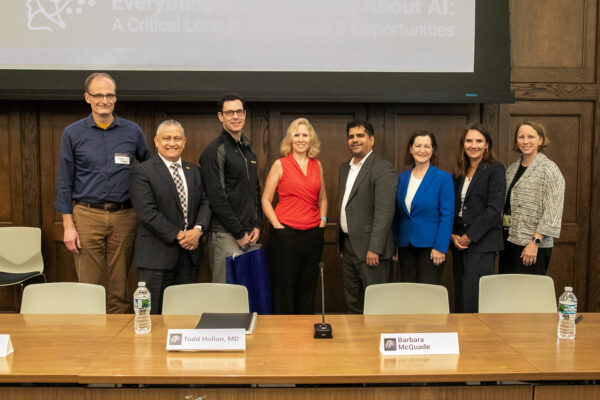
(L to R: Derek Peterson, associate chair of African History and chair of SACUA; Ravi Pendse, VPIT-CIO; Todd Hollon, MD, research professor of Neurosurgery; Amy Cohn, professor of Industrial and Operations Engineering; Neel Sukhatme (Moderator), David A. Breach dean of Law; Barbara McQuade, professor from practice / Michigan Law; Kayte Spector-Bagdady, research professor of Bioethics and associate professor of Obstetrics and Gynecology; Margaret Dobson, MD, clinical associate professor of Family Medicine, associate chair of Family Medicine)
Regulation and responsibility remained open questions. Barbara McQuade, professor from practice at Michigan Law, said the U.S. lacks comprehensive AI rules, and suggested an FAA-like approach that pursues benefits while reducing harms. Kayte Spector-Bagdady, a research professor of Bioethics and associate professor of Obstetrics and Gynecology and director of Michigan Bioethics, emphasized that accountability for outcomes is not new and that government can build on existing oversight structures. Chen added that AI companies often push accountability onto users for bad advice; he suggested systems might behave more ethically if they could learn from their own ethical reasoning.
In closing, Spector-Bagdady described Michigan’s “Leaders and Best” as a real commitment. Panelists debated what leadership should look like: Peterson advocated preserving “analog” paths to learning, while Cohn pointed to equity-focused uses (such as helping an international student polish grammar so instructors can better assess their ideas). Veal Jr. summed up the guiding question: Ask not what AI can do, but what it should do.


