
Written by James Dean, Cornell Chronicle.
Originally published on Michigan News.
An international team of astronomers, including Emily Rauscher of the University of Michigan, has generated the first 3D map of a planet orbiting another star. The map reveals an atmosphere with distinct temperature zones — one so scorching that it breaks down water vapor.
Study
Horizontal and vertical exoplanet thermal structure from a JWST spectroscopic eclipse map (DOI: 10.1038/s41550-025-02666-9)
“Partially, this result is really cool because it’s a demonstration of a new technique,” said Rauscher, U-M associate professor of astronomy. “Scientifically, this result is also really cool because, for this particular planet, it gets incredibly hot.”
The team, co-led by Ryan Challener of Cornell University and Megan Weiner Mansfield of the University of Maryland, published its findings in the journal Nature Astronomy.
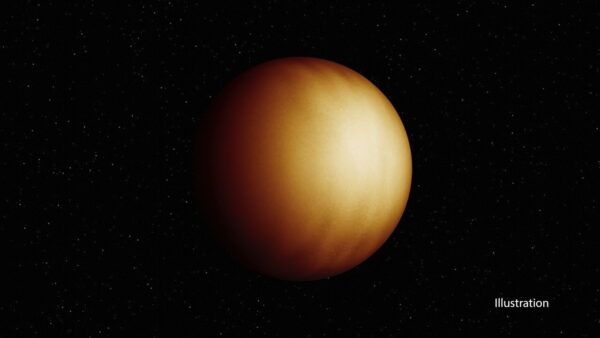
The team’s temperature map is of a planet known as WASP-18b, which is a gas giant, like Jupiter in our solar system, but it’s located 400 light years from Earth. It is so close to its star and so hot that scientists refer to it as an “ultra hot Jupiter.”
The team’s effort demonstrates a technique called 3D eclipse mapping, or spectroscopic eclipse mapping. The effort builds on a 2D model that members of the same team published in 2023, which demonstrated eclipse mapping’s potential to leverage highly sensitive observations by the JWST, Earth’s most powerful space telescope. Operated by NASA, the JWST is also supported by the European Space Agency and the Canadian Space Agency.
“Eclipse mapping allows us to image exoplanets that we can’t see directly, because their host stars are too bright,” said Challener, a postdoctoral associate at Cornell. “With this telescope and this new technique, we can start to understand exoplanets along the same lines as our solar system neighbors.”
Similar to how Earth-based telescopes enabled astronomers to start characterizing Jupiter’s Great Red Spot long ago, JWST will now enable scientists to start characterizing more exoplanet atmospheres with this technique, the team said.
Challener was previously a postdoctoral researcher in Rauscher’s group U-M, where he started developing computer code that could extract 3D thermal information from JWST’s data. Mansfield also has a U-M connection: Parts of the methodology she brought to the new project were seeded at a workshop hosted by Rauscher in 2018.
“I definitely have a bit of pride in that,” Rauscher said. “Here at Michigan, we’ve been able to contribute toward making this observation happen.”
The team included about three dozen researchers from more than 20 institutions worldwide. The research was supported by JWST’s Transiting Exoplanet Community Early Release Science Program.
Mapping distant skies
Detecting exoplanets is a challenge to begin with. Light from their host stars can overwhelm what’s emitted by the planets. In terms of brightness, exoplanets are typically less than 0.1% as bright as their stars.
“The analogy is a firefly in front of a lighthouse,” Rauscher said. “But we know when the planet is in front of and when it’s behind the star. We can actually measure that tiny little dip that had been light coming from the planet.”
JWST can precisely measure how that light is lost as the planet moves behind the star. This enables scientists to link minute changes in light to specific regions to produce a brightness map across a spectrum of different light wavelengths, or colors. That spectroscopic information can be converted to temperatures in three dimensions: latitude, longitude and altitude.
WASP-18b, which has roughly the mass of 10 Jupiters, orbits in just 23 hours and has temperatures approaching 5,000 degrees Fahrenheit. That provided JWST with a relatively strong signal, making it a good test case for the new mapping technique.
The new view of the exoplanet confirmed spectroscopically distinct regions in WASP-18b’s visible “dayside,” the side always facing the star due to its tidally locked orbit. The planet features a circular “hotspot” where the most direct starlight lands, and where winds appear too weak to redistribute the heat. Surrounding the hotspot is a colder ring nearer the planet’s outer visible edges, or limbs. Notably, Challener said, measurements showed lower levels of water vapor in the hotspot than WASP-18b’s average.
“We think that’s evidence that the planet is so hot in this region that it’s starting to break down the water,” Challener said. “That had been predicted by theory, but it’s really exciting to actually see this with real observations.”
Additional JWST observations could help improve the first 3D eclipse map’s spatial resolution, the team said. And the technique can already help map the 3D temperature variation of other hot Jupiters, which account for hundreds of the more than 6,000 exoplanets confirmed to date.
“One of the really cool things about exoplanets is that most of the planets we found are completely unlike the ones in our solar system,” Rauscher said. “And so it’s a lot of fun to try and figure out how we take what we understand, more or less, in our solar system and stretch it to these very different situations.”


