
Student Training
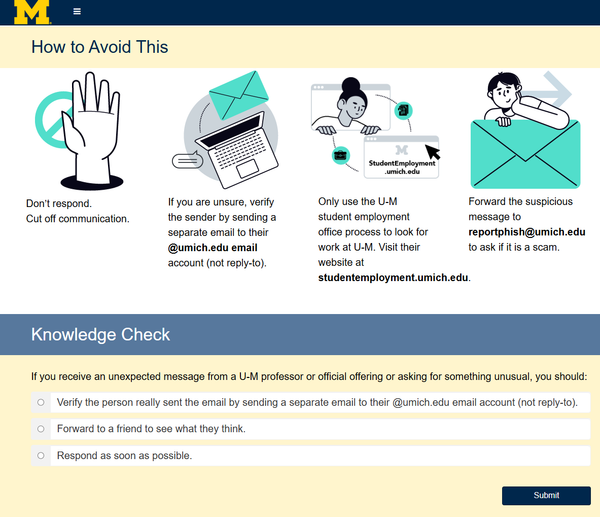
To ensure students are prepared for the types of phishing and scams that are specific to U-M, incoming undergraduate and graduate students across all campuses are required to complete new training titled “Safe Computing for Students.” It is designed to help students protect themselves by avoiding scams that could cost them money, account compromises, or loss of sensitive, personal information. The new course is delivered alongside other required training for all incoming students on topics including alcohol use, mental health, sexual assault prevention, and hazing.
Asmat Noori, Executive Director of Information Assurance and Chief Information Security Officer, emphasized the value of the training.
“Every student relies on technology every day, which means every student has a role in cybersecurity,” he said. “Basic security awareness training gives everyone a shared foundation and some simple, practical tools to better protect themselves and their accounts.”
Over 14,000 students on the Ann Arbor, Flint, and Dearborn campuses have completed the new “Safe Computing for Students” course, which exceeded the expected 70% of the targeted audience on the Ann Arbor campus. And because cybersecurity threats are an ongoing issue, the “Safe Computing Challenge” will continue to be offered each October as a voluntary quiz with prize incentives. Both trainings include examples of phishing and other threats and will be refreshed each year based on real activity at U-M, so students should be prepared if they encounter them in their inboxes or on social media.
Faculty and Staff Training
A new course, DSE102: Data Request Management, has been published in My LINC. It builds on DSE101: Introduction to Data Stewardship at U-M and covers roles, responsibilities, and processes for assessing data requests, documenting decisions, and more.
The “DCE101: Cybersecurity and Data Protection at U-M” course, which is required annually, has also been updated with new examples of phishing and scams for this year.


