

Back in the 1950s, when computers were anything but personal, filling up entire rooms and operated by trained professionals using paper punch cards, U-M was a leader in computer science and technology. Yet, there was no “computer science” degree as we know it now. Instead, researchers and scholars interested in computing collaborated under the umbrella discipline of the “communication sciences,” situated inside the College of Literature, Science, and the Arts (LSA).
Within LSA, researchers came together to form Michigan’s Logic of Computers Group, founded in 1956 by Arthur Burks, a philosopher-turned-computer scientist. Like many research collaborations of the time, there was an expectation that scholars in the group essentially replace their own salaries through grants and government contracts, which were plentiful during the Cold War era when a hallmark of our strength as a nation was measured in research output. While government contract work was often a focus for members of the group, Burks’s larger intellectual interests stemmed from the belief that computing was not merely machine-building but instead the study of logical systems, natural and artificial, and that an interdisciplinary approach was vital.
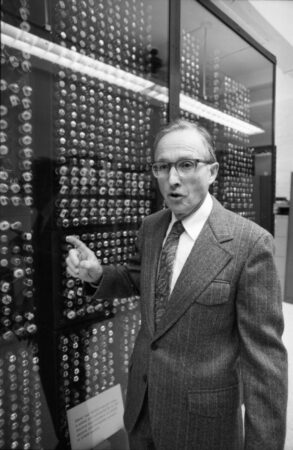
Michigan alumnus Sam Franz (A.B. ’20), a historian of early computing and a current doctoral student at the University of Pennsylvania, describes Burks’s approach as a common one. “Early computing across the United States was a soup of different disciplines,” he says. “At Michigan, the thesis was that computers could solve problems in other fields, so it was best to collaborate with scholars in other fields, including medicine, biology, and psychology.”
According to Franz, this philosophy of deep collaboration was likely influential in creating the foundation for fruitful teamwork between two Rackham alumni and former Logic of Computers Group members: Jim Thatcher (Ph.D. 1963) and his professor-turned-colleague Jesse Wright (MA 1945, Ph.D. ’51). Departing from U-M in 1963, both Thatcher and Wright went on to pursue careers at IBM, where they are credited with the creation of the company’s first screen readers, technology to assist blind and low-vision people with computing. Wright, who was blind, brought critical perspectives, skills, and experience to that work.
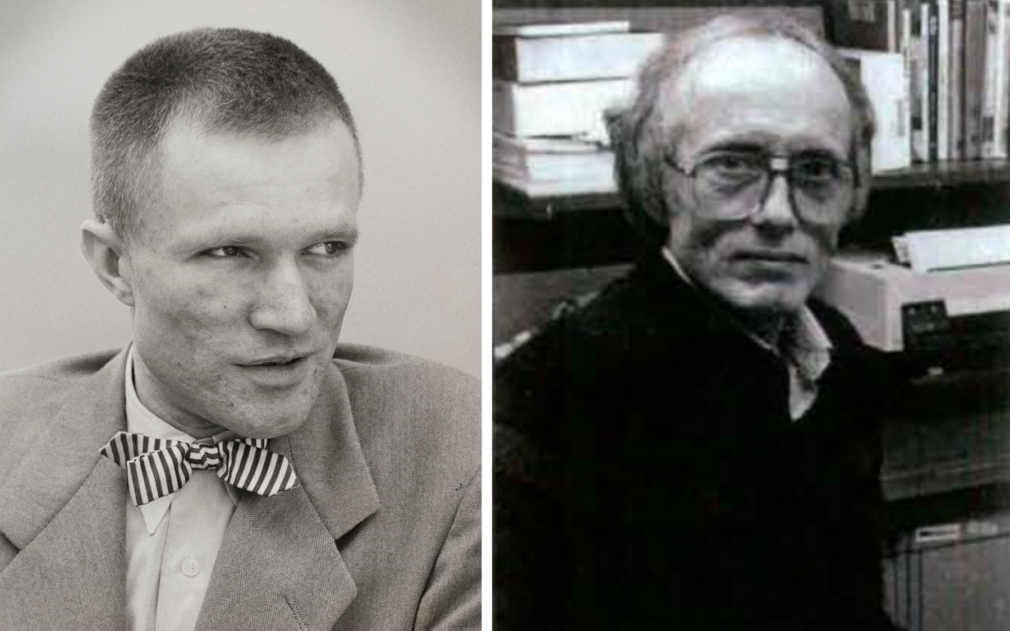
“Computing in the 1950s, when Thatcher and Wright were at U-M, was very much about understanding human-computer interaction,” Franz says. “There was no mouse, no keyboard, and no computer monitor as we understand them today. So, working with a mathematician who was blind would mean that the problem of man-machine communication would take different forms as these technologies developed.”


