
AI is changing how technical work gets done at U-M — not just by introducing new tools, but by changing what it means to build.
That shift was on full display in June at U-M’s second annual AI Dev Day, hosted jointly by Information and Technology Services (ITS) and the School of Information, where technical builders, developers, and curious minds from across campus gathered to share what they’re building, how they’re working differently, and what they’re learning along the way.
Far from a beginner’s workshop, the event was designed specifically for technical professionals actively building automated workflows, custom systems, and code. Across keynotes, lightning talks, and hands-on tracks, the event showcased practical use cases currently running across the university, including automated document parsing, front-line support agents, deep terminal-based coding, and more.
By providing flexible APIs, low-code platforms, and pre-built components, U-M’s Emerging Technology is changing how technical work gets done. Rather than getting bogged down in syntax, builders are empowered to focus on judgment, strategy, and architecture — reinforcing that AI isn’t taking over technical roles, but shifting human builders up the value chain.
Shifting Mindsets from “How Do I Build This?” to “Is This Worth Building?”
The opening keynote talk, presented by David Jurgens, associate professor of information, electrical engineering, and computer science, and Michael Hess, chief information officer for the School of Information, set a grounded tone for the day.
“Models are like mad-libs trying to fill in the next blank,” Jurgens said.
Your model is only as good as what you give it.
— Michael Hess
Rather than treating AI like a panacea, the speakers candidly addressed its limitations.
“Keep in mind AI is a three-year-old,” Hess added. “Three-year-olds really aren’t well behaved some of the times. These models are really good at what they do, but they are also at times incredibly stupid. Your model is only as good as what you give it.”
Because large language models rely entirely on the context and structure provided to them, keeping a Human-in-the-Loop (HITL) is essential for quality, ethics, and accuracy. As Hess noted, using AI tools effectively relies on shifting your mindset from that of executing every manual line of labor to directing the work, which includes owning the judgment, establishing strict requirements, maintaining critical oversight, and guiding the overall outcome.
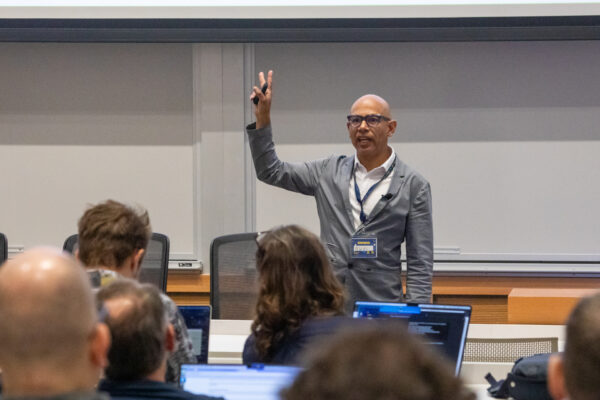
Closing keynote speaker Nigel Melville
Closing out the day, keynote speaker Nigel Melville, associate professor of technology and operations, reflected on how major technology waves consistently reshape how work and research get done. The goal of U-M’s Emerging Technology initiatives isn’t to flood campus with a catalog of disconnected, disparate tools, but to provide a cohesive foundation where anyone can bring life to their ideas. AI might generate the code or structure the dataset, but the direction, ethics, and vision belong to you.
Democratizing Development, Expanding Contribution, and Scaling Responsibly
This shift in technical responsibility comes at a time when AI is expanding who can contribute to building and automation. Low-code tools and agentic platforms lower the entry barrier for domain experts to prototype ideas, but bringing those tools to production still relies heavily on technical expertise to integrate, secure, and scale them responsibly.
Sam Seaver, a campus computing services administrator with ITS, highlighted this collaborative dynamic during his presentation on ‘Byte Buddy,’ an internal support tool that parses thousands of tickets and knowledge articles to generate step-by-step troubleshooting guides for staff.
“Last year I was sitting in the audience of Dev Day, and I saw some absolutely incredible presentations,” Seaver said. “I sat there thinking, ‘I can’t do that. I’m not a programmer, I’m not a developer, what am I doing here?’ And to be fair, I was partly right. I could not do this alone. We had to bring together the right people and the right team, and now… we were able to build something we’re really proud of.”
Through tools like U-M AI Workflows (powered by n8n) and agentic environments like Claude Code, technical staff and domain specialists are partnering to automate complex tasks, streamline support operations, and eliminate manual bottlenecks without sacrificing production rigor or data control.
Security First: Innovation Within a “Walled Garden”
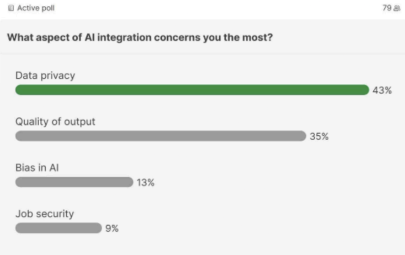
During a live audience poll, attendees were asked what aspect of AI integration concerned them most. The top concern was overwhelmingly data privacy (43%), followed by quality of output (35%).
To address these concerns, the ITS Emerging Technology Team walked through the U-M AI Stack. Unlike consumer subscriptions or third-party platforms where data can inadvertently train external models or pose security risks, U-M’s AI infrastructure (including U-M GPT and the U-M GPT Toolkit API) is built specifically for the university:
- Privacy by Design: Data remains safely within U-M’s secure cloud environment and is approved for certain types of sensitive data. Campus inputs are never used to train external public models.
- Flexibility & Stability: Researchers and developers gain access to a unified API endpoint covering multiple leading models. The team explicitly maintains model longevity to ensure long-term research grants and multi-year projects aren’t disrupted by rapid vendor deprecation.
- Accessibility & Cost: Tools are provided at no cost or passed through at direct cost, removing financial and technical friction for campus teams.
What’s Next
AI Dev Day is just one part of a growing conversation. Throughout the year, we’ll be hosting Dev Day Deep Dives — smaller, focused sessions that go deeper on the tools, techniques, and use cases introduced at the main event. Whether you’re looking to get hands-on with a specific platform or want to see how others on campus are solving problems similar to yours, these sessions are designed to meet you where you are.
To stay in the loop on Deep Dives, future Dev Day events, and other emerging technology opportunities, join our MCommunity group: Dev Days & Deep Dives.


