Discover stimulating, educational, and family-friendly scientific events.
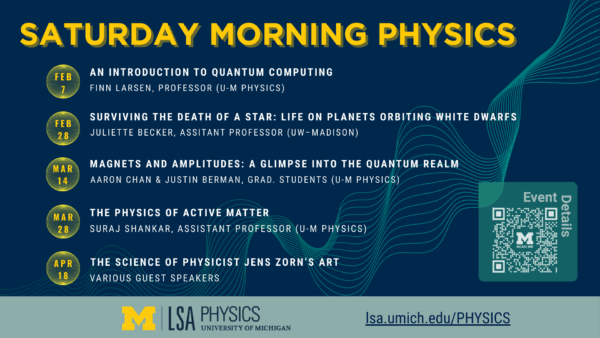
Each Saturday Morning Physics lecture begins promptly at 10:30 a.m. and lasts until 11:30 a.m., followed by a half-hour Q&A session. Note: There is a pause between the talk and the Q&A for patrons to leave if needed.
Winter 2026 Schedule
Surviving the Death of a Star: Life on Planets Orbiting White Dwarfs
- When: February 28
- Where: 170 & 182 Weiser Hall and live-streamed on: https://myumi.ch/rA5xG
- Who: Juliette Becker, Wisconsin Center for Origins Research (University of Wisconsin-Madison)
- What: When stars like the Sun die, they leave behind stellar remnants that we call white dwarfs. Usually, when we think about life in planetary systems, we think about it existing on planets orbiting stars like the Sun – but in this talk, I’ll explore how planets can survive the death of their stars and whether oceans (and potentially life) could exist on planets orbiting around white dwarfs. I’ll explain the physics of tidal heating, planetary migration, and how telescopes like the James Webb Space Telescope could one day detect signs of life in these unlikely worlds.
The Van Loo Family Student Presentations: Magnets and Amplitudes: A Glimpse into the Quantum Realm
- When: March 14
- Where: 170 & 182 Weiser Hall and live-streamed on https://myumi.ch/5kVRx
- Who: Aaron Chan and Justin Berman (U-M Physics Graduate Students)
- What:
Aaron Chan, “Extreme Magnetic Fields: How and Why“
Laboratory experimental apparatus can produce magnetic fields up to 100T — about 30 times stronger than hospital MRI machines and 10,000 times larger than a regular fridge magnet. In this talk, I will discuss the cutting-edge technology used by the National High Magnetic Field Laboratory to produce such powerful magnetic fields and the interesting physical phenomena probed in such extreme environments.
Justin Berman, “Bootstrapping High-Energy Theories from Low-Energy Clues”
A key goal of particle physics theories is to predict how particles scatter off one another. However, experimentally probing these interactions at very high energies is extremely difficult. In this talk, I explain how fundamental principles of physics let us “bootstrap” low-energy data into predictions about high-energy particles, independent of the underlying theory. By using this bootstrap technique, I show that we can find upper and lower limits on the masses of particles in an approximation of the real world, which predict the existence and properties of a massive particle that has not yet been observed.
The Physics of Active Matter
- When: March 28
- Where: 170 & 182 Weiser Hall and live-streamed on: https://myumi.ch/15zPM
- Who: Suraj Shankar, Professor (U-M Physics)
- What: Birds flock. Bees swarm. Fish school. These natural collective behaviors emerge in a new kind of matter – active matter – made not of atoms and molecules but of entities that consume energy to generate their own motion and forces. I will discuss how advances in the exciting field of active matter are helping us understand grand challenges in biology, and begin to answer an age-old question: What makes matter come to life?
The Science of Physicist Jens Zorn’s Art
- When: April 18
- Where: 170 & 182 Weiser Hall and live-streamed on: https://myumi.ch/Z24qp
- Who: Multiple U-M Faculty Speakers
- What: Jens Zorn was a Michigan Physics professor, molecular physicist, and renowned teacher and academic administrator. He was also an artist who began a second career in earnest in the 1990’s, creating sculptures that commemorated great discoveries and undertakings in physics and optics. Join us on April 18, 2026, for a visual tour of Jens Zorn’s creations with introductions to the science behind the sculptures presented by U-M faculty.
Sponsors
The Saturday Morning Physics program is sponsored by:
- The Dr. Mary Lois Tiffany Endowment by Dr. O. Lyle Tiffany and Dr. M. Lois Tiffany, who were the first to support the Saturday Morning Physics program in May 2000.
- The Hideko Tomozawa Endowment in memory of Hideko Tomozawa in recognition of her interest and loyal participation in the Saturday Morning Physics program.
- The Van Loo Family Endowment to support outstanding University students who present public lectures at Saturday Morning Physics.
- The Pulikeshi Dayalu Astrophysics Fund to support one lecture per year, giving preference to an Astrophysics themed talk.
- Friends of the Program – Donations of all sizes are needed to keep this program alive!


